Skip to content

Agent orchestration

AI agent orchestration platform for AI-built apps

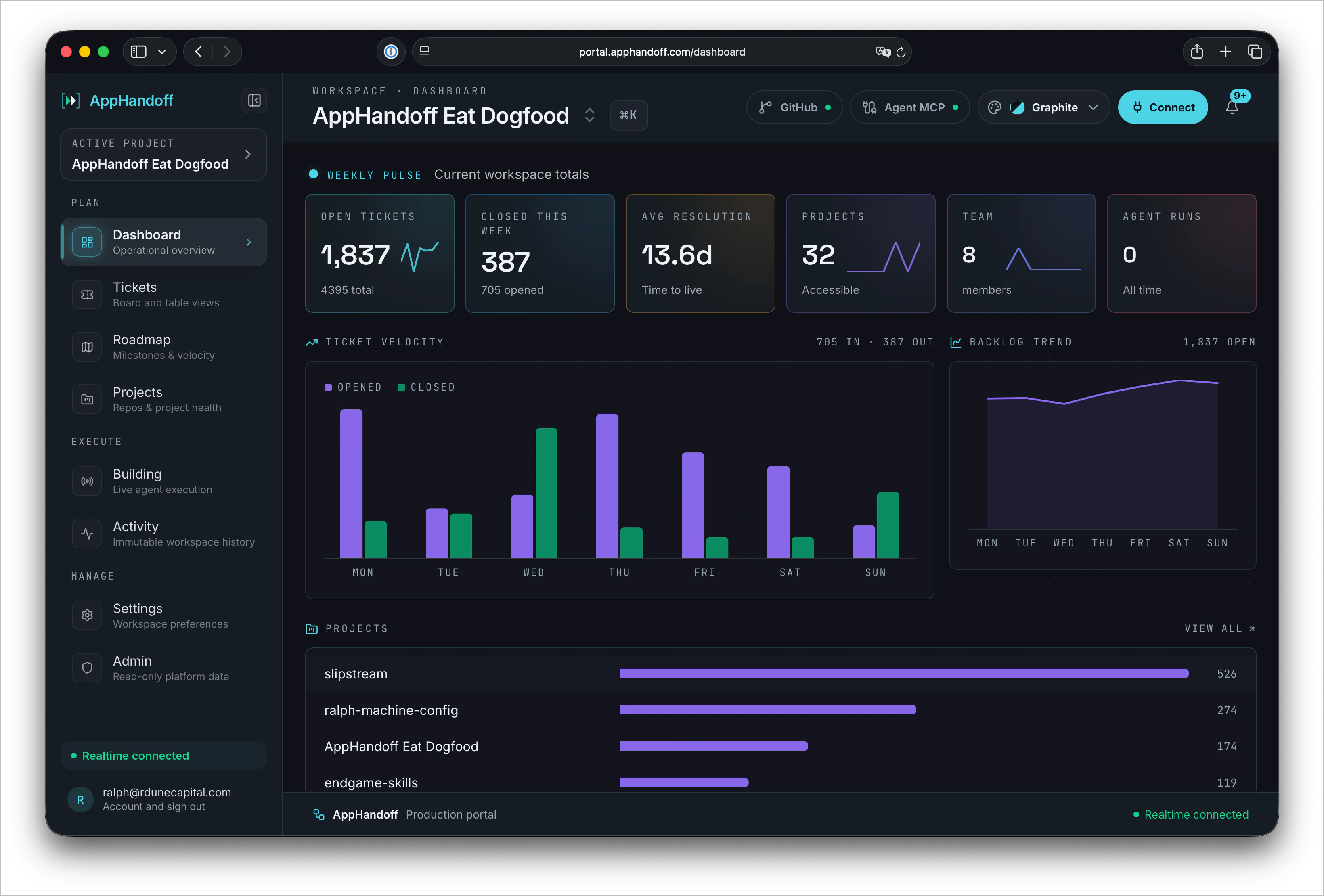
AppHandoff is an AI agent orchestration platform for teams building software with AI coding agents. It coordinates multiple agents — Claude Code, Cursor, Codex, Lovable — through shared handoff tickets, role assignments, milestones, and a hosted MCP gateway, so each agent sees what is assigned, ready, or blocked instead of colliding in the same codebase.

What agent orchestration means

Agent orchestration is the coordination of multiple AI agents working toward one outcome: assigning tasks, sharing state, sequencing dependent work, and resolving conflicts between agents. In software delivery it means getting coding agents — Claude Code, Cursor, Codex, Lovable — to build one coherent application instead of four diverging interpretations of it.

A single agent with a large context window can hold one task well. It cannot hold a team. Context windows are per-session: when a Cursor session and a Claude Code session work the same repo, neither knows what the other changed, decided, or broke. Past a couple of agents, the bottleneck is no longer model quality — it is the absence of shared, durable state between sessions. Providing that shared state is the job of agent orchestration tools.

The coordination problem: collisions, duplicates, drift

Teams running multiple agents without orchestration hit the same failure modes in a predictable order. Two agents pick up the same bug and produce conflicting fixes. A frontend agent invents an API field the backend never returns. A backend agent renames an endpoint and nothing tells the screens that consume it. Work gets done twice — or worse, undone.

The usual workaround is a human relay: copy context out of one chat window, paste it into another, repeat until something ships. That caps throughput at the speed of the human in the middle and loses everything that was not pasted. Orchestration replaces the relay with a shared source of truth every agent can query directly.

  • Collisions — two agents mutate the same file, endpoint, or schema concurrently
  • Duplicate work — agents independently claim the same task with no way to see it is taken
  • Contract drift — frontend and backend evolve separately until the API no longer matches
  • Lost context — decisions live in one session's history and vanish when it ends

How AppHandoff orchestrates AI agents

AppHandoff is a hosted MCP server and coordination layer for AI-built apps. Agents connect over the Model Context Protocol — Claude Code, Cursor, Codex, any spec-compliant client, and Lovable through its MCP integration — and get a shared set of orchestration tools: handoff tickets (HO-1, HO-2, …) on a shared Kanban, role assignments, milestones, and live contract data scanned from your actual repos.

Because AppHandoff connects both the frontend and backend GitHub repos and scans them, the orchestration layer is contract-aware. Agents can query the API spec, the database schema, route-level usage, and a frontend/backend mismatch report as MCP tools — so coordination decisions are grounded in what the code actually does, not what an agent remembers it doing. The ask_apphandoff gateway tool takes a natural-language request and routes it to the right tool, so an agent does not need to memorize the catalogue.

  • Handoff tickets on a shared Kanban — backlog, up next, in progress, validation, live
  • Role lifecycle per ticket — backend, frontend, and QA roles tracked independently, with a human verification gate before live
  • Mismatch detection between frontend expectations and backend reality
  • Deploy checks and health dashboards agents can read before and after shipping
  • ask_apphandoff — one gateway tool that routes plain-language asks to the right call

Orchestration patterns: hub and spoke, roles, milestones

The pattern that holds up in practice is hub and spoke — with the ticket board, not a manager agent, as the hub. In orchestration-pattern terms that makes it a blackboard rather than orchestrator-worker: agents are spokes that ask for their workload, claim a ticket, report progress, and close with a resolution note. No agent talks to another agent directly — they coordinate through durable state both can read. When a session dies mid-task, the ticket still says exactly where the work stopped.

Role lifecycle handles work that crosses specialties. One ticket can carry backend, frontend, and QA roles, each tracked independently from pending to done — the backend agent finishes its role and the frontend role becomes actionable, with the contract change attached. Milestones group tickets into a release plan so agents pull the next ready item in a sequence a human chose, instead of self-assigning whatever looks interesting.

Agent orchestration frameworks vs an orchestration platform

An agent orchestration framework — LangGraph, CrewAI, AutoGen, and similar — is a code library for building a multi-agent application: you define the agents, wire the graph, and own the runtime. That is the right tool when the agents are the product, and most LLM orchestration tooling lives in this category.

An AI agent orchestration platform solves a different problem: coordinating agents you already run and did not build — the coding agents inside your team's IDEs. AppHandoff is the platform case. There is no graph to define and no runtime to host; agents keep running where they run today and coordinate through shared tickets and contract state over MCP. The two approaches are complementary — an agent built with a framework can connect to AppHandoff as just another MCP client.

MCP vs A2A: how agents communicate

There are two emerging answers to the agent communication protocol question. MCP standardizes how an agent talks to tools and context: one client, many servers, structured calls. A2A-style protocols standardize how agents talk to each other directly: capability discovery, task delegation, message passing between autonomous peers.

AppHandoff deliberately builds on MCP with shared state in the middle — closer to a blackboard than a phone call. Agents communicate by writing to and reading from durable tickets rather than messaging each other. The honest trade-off: direct agent-to-agent delegation is more expressive, but shared-state coordination works today with every MCP client, survives session restarts, leaves a full audit trail, and keeps humans in the loop by default, because they read the same board. For coding work — where most coordination is 'what changed, what is blocked, who owns this' — durable state has proven the more robust medium.

How to start orchestrating your agents

Setup is deliberately thin. Create an AppHandoff project, connect the frontend and backend GitHub repos, and let the scan build the contract picture: API spec, database schema, route-level usage, mismatches. Then add the hosted MCP endpoint — https://api.apphandoff.com/api/mcp-bot — to each agent. Authentication is OAuth 2.1 (API keys are available on the REST API), transport is Streamable HTTP, and there is nothing to install or self-host.

From there, orchestration is incremental. Start with one agent reading tickets, add a second on a different role, and let the board absorb the coordination the human relay used to do.

  • 1. Create a project and connect your frontend and backend repos
  • 2. Let the scan expose API contracts, schema, and mismatch reports as MCP tools
  • 3. Add the MCP endpoint to Claude Code, Cursor, Codex, or Lovable and authenticate with OAuth 2.1
  • 4. File work as handoff tickets; agents query their workload, claim, build, and close

Where multi-agent orchestration is heading

The direction of travel is clear: more agents per developer, longer-running sessions, and agents that delegate to other agents. Every step up in parallelism raises the cost of coordination done by hand and the value of coordination done through durable shared state. Multi-agent orchestration is moving from prompt engineering — pasting context between windows — to infrastructure: queryable boards, contract-aware scans, and AI orchestration surfaces both agents and humans can audit.

Protocols will keep converging. MCP has become the default way agents reach tools; agent-to-agent standards are still settling. The practical bet AppHandoff makes is that whatever the messaging layer ends up looking like, teams will still need the thing underneath it: one shared, inspectable record of what is assigned, what is ready, what is blocked, and what actually matches production.

FAQ

What is AI agent orchestration?

AI agent orchestration is the coordination of multiple AI agents working on a shared goal — assigning tasks, sharing state, sequencing dependent work, and resolving conflicts. In software teams it typically means coordinating coding agents like Claude Code, Cursor, and Codex across one codebase so they build a coherent application instead of colliding.

What is the difference between an agent orchestration framework and an agent orchestration platform?

A framework (LangGraph, CrewAI, AutoGen) is a library you code against to build your own multi-agent system — you define the agents and own the runtime. A platform coordinates agents you already run, like IDE coding agents. AppHandoff is a platform: agents connect to a hosted MCP endpoint and coordinate through shared tickets, roles, and contract state, with nothing to host.

How do AI agents communicate with each other?

Today, mostly indirectly. MCP gives agents a standard way to call tools and read shared context, while A2A-style protocols for direct agent-to-agent messaging exist but are less established. AppHandoff uses MCP with durable shared state — agents communicate by writing to and reading from handoff tickets, which survives session restarts and keeps humans in the loop.

Can I orchestrate agents from different vendors at the same time?

Yes. AppHandoff is client-agnostic: Claude Code, Cursor, Codex, and any spec-compliant MCP client connect to the same hosted endpoint, and Lovable connects through its MCP integration. All of them see the same tickets, roles, milestones, and mismatch reports, so cross-vendor agents coordinate without custom glue.

Do I need a manager agent to orchestrate the others?

No. When the hub is a shared ticket board rather than a manager agent, there is no central controller to fail: each agent queries its workload, claims a ticket, and reports status independently. A human (or a planning agent) curates the backlog and milestones, but no single agent has to stay alive to keep the system coordinated.

Next step

See the full workflow in context

Explore pricing and comparisons from the same public AppHandoff site before connecting your first project.