Skip to content

AI agent coordination

Coordinate the AI coding agents already in your stack.

AppHandoff is the coordination layer for AI coding agents — a shared Kanban and hosted MCP server that hands Cursor, Claude Code, and Lovable the same context, contracts, and handoff tickets before they write code. Ten capabilities ship today; none are demos. Each maps to a code module you can audit, from plan through build to ship.

Jump to01Plan02Build03Ship
01Plan

Roadmap planner

Turn a spec into tickets — and find what isn't built

Upload your roadmap. See what isn't built yet.

AppHandoff's roadmap planner runs a requirements gap analysis: it reads your spec or roadmap PDF, diffs every requirement against the code in your connected repos, and turns each gap into a ticket. Instead of guessing what is left, you get a spec-to-tickets map of exactly what your AI coding agents still need to build.

In the codeRequirementPlannerDialog.tsxRequirementWizardStepper.tsxRequirementUploadStep.tsx

Roadmap planner wizard comparing an uploaded spec against the connected repos and proposing missing tickets.

02Build

Plan-before-code review

An AI code-review agent that reviews the plan before code

Read the agent's plan before it writes a line of code.

Plan-before-code review puts an AI code review agent between intent and implementation. The agent drafts a summary, steps, risks, and open questions; you approve, redirect, or cancel from one view before it writes a line. Reviewing the plan before code means an agent never burns a run building the wrong thing.

In the codePlanReviewModal.tsxBotPlanPanel.tsxuse-cancel-bot-plan.ts

Plan review modal showing a bot's proposed steps, risks, and questions, with approve/redirect/cancel controls.

03Ship

Merge-to-close inbox

Auto-close tickets on merge with commit-to-ticket matching

Tickets close themselves when the work actually lands.

The merge-to-close inbox auto-closes tickets on merge. When a commit lands, AppHandoff runs commit-to-ticket matching, scores each acceptance criterion against the diff, and queues a one-click close with a confidence percentage. Your board reflects what actually shipped — no agent or human has to remember to move the card.

In the codeMergeCloseInbox.tsxmcp-handlers/merge-close.tshandoff-merge-close.ts

Merge-close inbox showing suggested ticket closures with confidence percentages and per-criterion verdicts.

More you get

Six more capabilities that earn their place on the dashboard.

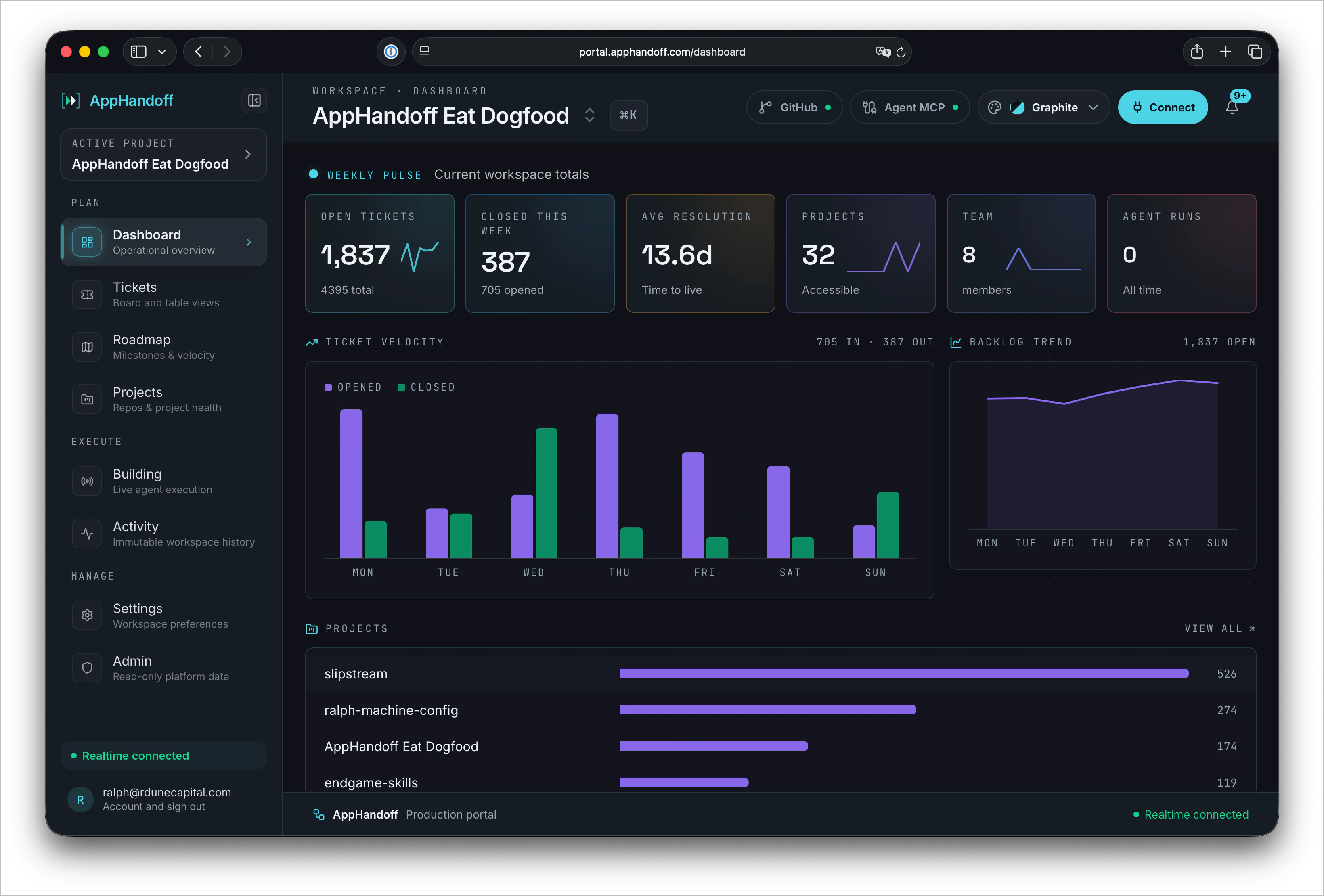
Live presence, scoring, deployment state. Everything an agent — or a human — needs to know what's already done.

Live agent presence

Track AI agent work in real time

Live agent presence lets you track AI agent work as it happens. A real-time list shows every connected MCP session — Cursor, Claude Code, Lovable — with its role and origin. When you wonder what your AI agent is doing right now, the answer is one glance at the dashboard, not a guess.

Per-ticket agent timeline

An AI agent activity timeline for every ticket

The per-ticket agent timeline is an AI agent activity timeline: checkpoints, work segments, an active-session banner, and blockers, all in real time. You see exactly what an agent did, when each work checkpoint landed, and where it got stuck — so a stalled run is obvious instead of silent.

Ticket completion score

A ticket completion score that means ready to ship

The ticket completion score turns “is this done?” into one number. It weights role progress, merged, and deployed as 60 · 20 · 20 into a ready-to-ship score you can sort the board by. Instead of trusting a status label, you see how complete each ticket truly is across humans and AI agents.

Project rules agents will read

Set rules for AI coding agents once

Project rules are guardrails for AI coding agents you write once. Plain-text rules attach to a project and surface through MCP, so Cursor, Claude Code, and every connected agent read the same constraints on every call. One set of rules for AI coding agents keeps each agent inside the lines without repeating yourself.

Deployment attach + ship tracking

Ticket-to-deploy tracking: merged vs deployed

Deployment tracking follows a ticket from merged to deployed to live. Bind Fly apps or any environment to a project and each ticket tracks real deploy state, not a checkbox. The merged-vs-deployed distinction is explicit, so a closed ticket never gets mistaken for one that has actually shipped to users.

Featured

Single-call ticket bundle

MCP build context in a single call

One MCP call per ticket, not twelve.

The single-call ticket bundle hands an agent all its MCP build context at once. One get_build_bundle call returns the code references, acceptance criteria, and contracts for a ticket — the full agent task context in a single response, instead of a dozen round-trips before any code gets written.

mcp-handlers/build-bundle.ts

FAQ

Coordinating AI coding agents, explained.

What is an AI agent handoff?

An AI agent handoff is the transfer of work between AI coding agents — or between an agent and a human — with the full context attached: the plan, acceptance criteria, contracts, and code references. AppHandoff turns each handoff into a ticket so Cursor, Claude Code, and Lovable pick up exactly where the last one left off.

What is a shared Kanban for AI coding agents?

A shared Kanban for AI coding agents is one board where humans and multiple AI agents track the same tickets in real time — backlog, plan, build, review, ship. Instead of each agent working blind in its own chat, AppHandoff gives them a single source of truth for what is done, in progress, and blocked.

How do you coordinate multiple AI coding agents like Cursor, Claude Code, and Lovable?

You coordinate multiple AI coding agents by giving them shared project context before they write code. AppHandoff is a hosted MCP server that hands every connected agent the same rules, contracts, and tickets, then tracks each one's work on a shared Kanban so their changes converge instead of conflicting.

What is an MCP server and how does AppHandoff use one?

An MCP (Model Context Protocol) server exposes tools and context to AI agents over a standard protocol. AppHandoff runs a hosted MCP server so Cursor, Claude Code, and any MCP client read the same project rules, build bundles, and handoff tickets — one call returns the code refs, acceptance criteria, and contracts an agent needs.

Can AppHandoff review an AI agent's plan before it writes code?

Yes. AppHandoff's plan-before-code review has the agent draft a summary, steps, risks, and open questions first. You approve, redirect, or cancel from the same view before a single line is written — so an agent never burns a run building the wrong thing.
Open beta

Ten features. One workflow.
$8/month, unlimited projects.

Connect a repo, point your agents at the MCP, and watch a plan turn into a merged PR turn into a deployed ticket — without losing track of which one was which.